RawLaw.in - Legal News-First Platform Architecture
Connecting legal publishing, citizen legal-help journeys, advocate discovery, and operational workflows across independently scalable systems.
- Contribution
- Product architecture, frontend systems, user journeys, SEO, accessibility planning, performance strategy, and platform governance.
- Author
- Mohit Pandey
- Published
- Last reviewed
Executive summary
RawLaw combines legal publishing with structured paths from information discovery to legal-help intake and advocate participation. The platform direction separates editorial content, application workflows, APIs, and administration so that each surface can evolve around a clear responsibility.
The editorial website and advocate-registration flow are publicly accessible. Marketplace, workspace, payment, notification, review, moderation, and wider governance capabilities remain in active development or are part of the documented product direction.
Problem and opportunity
Legal information, professional discovery, issue intake, and matter management often exist as disconnected experiences. A visitor may find a useful article but still lack a clear next step. An advocate may maintain a profile while remaining disconnected from the informational journeys that create relevant demand.
The product opportunity is to connect trusted editorial discovery with structured and privacy-conscious action paths. Separating content from transactional systems allows each experience to maintain appropriate performance, governance, and operational controls.
Contribution and responsibilities
The work spans product architecture, frontend systems, search strategy, accessibility, and cross-surface user journeys.
- Define domain boundaries across editorial, application, API, and administration surfaces.
- Shape responsive journeys for news, discovery, registration, and guided legal-help intake.
- Plan crawlability, structured data, internal linking, indexation, and answer-focused content architecture.
- Establish accessibility, performance, progressive enhancement, privacy, moderation, and governance requirements.
- Map the relationships between citizen, advocate, editorial, and administrative workflows.
Publicly visible work and active development
This distinction keeps published evidence separate from planned or incomplete capabilities.
Publicly visible
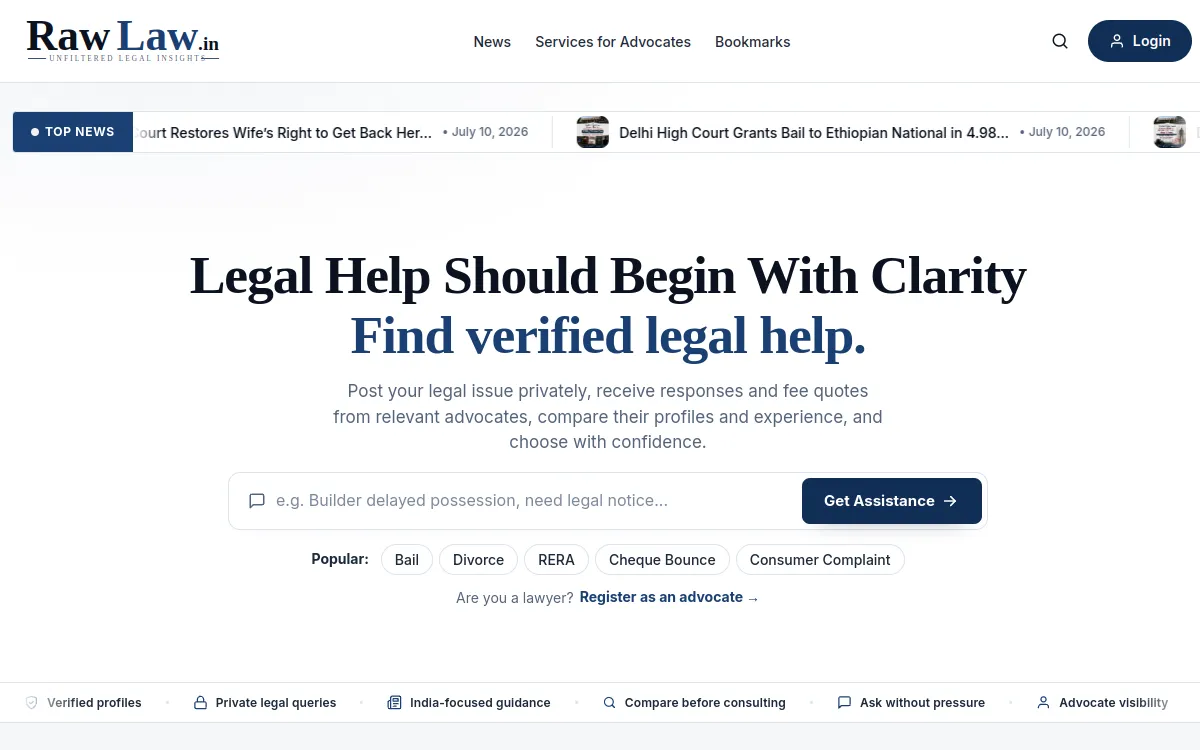
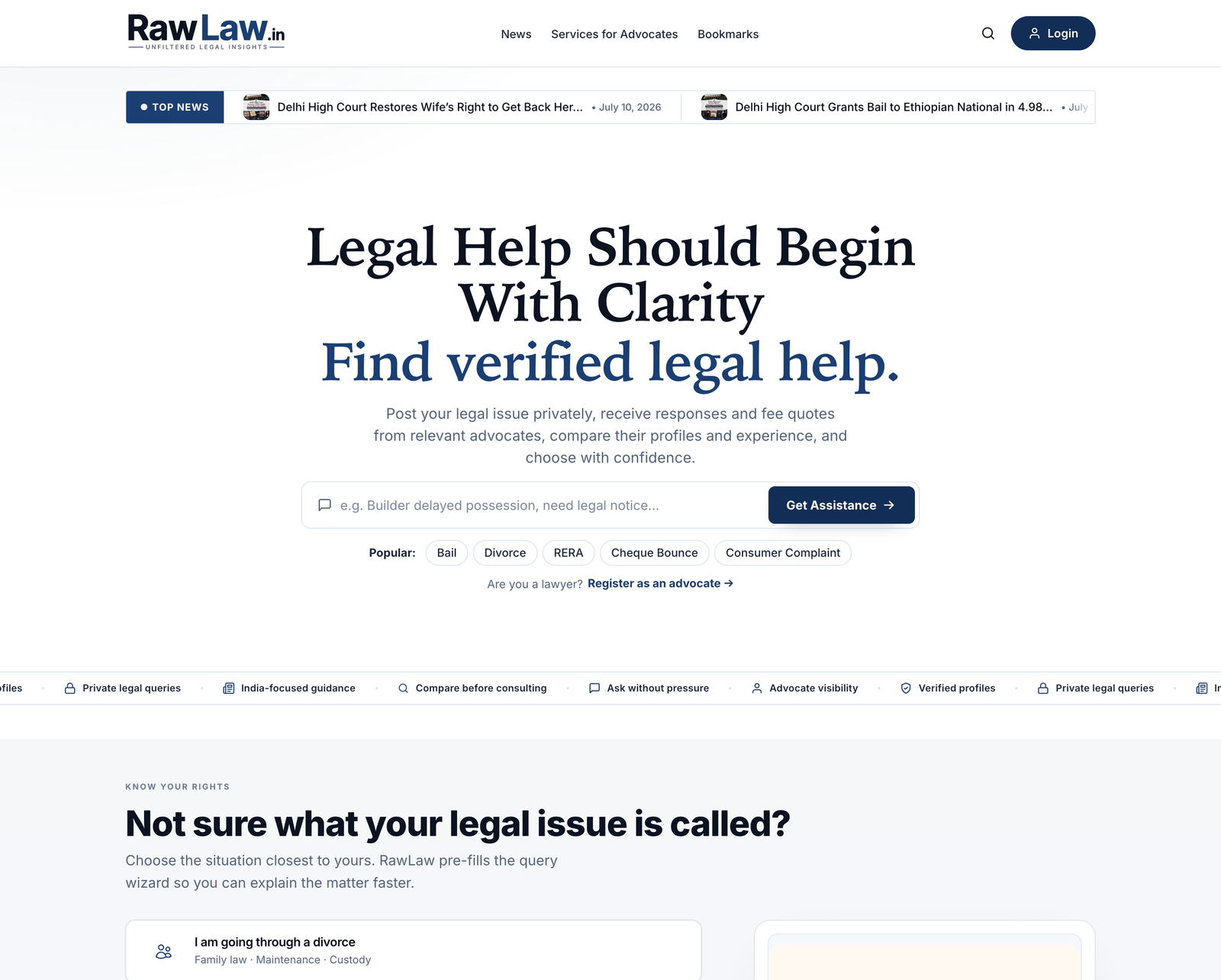
- Legal editorial and news publication at rawlaw.in.
- Legal-help entry points and structured issue prompts on the public website.
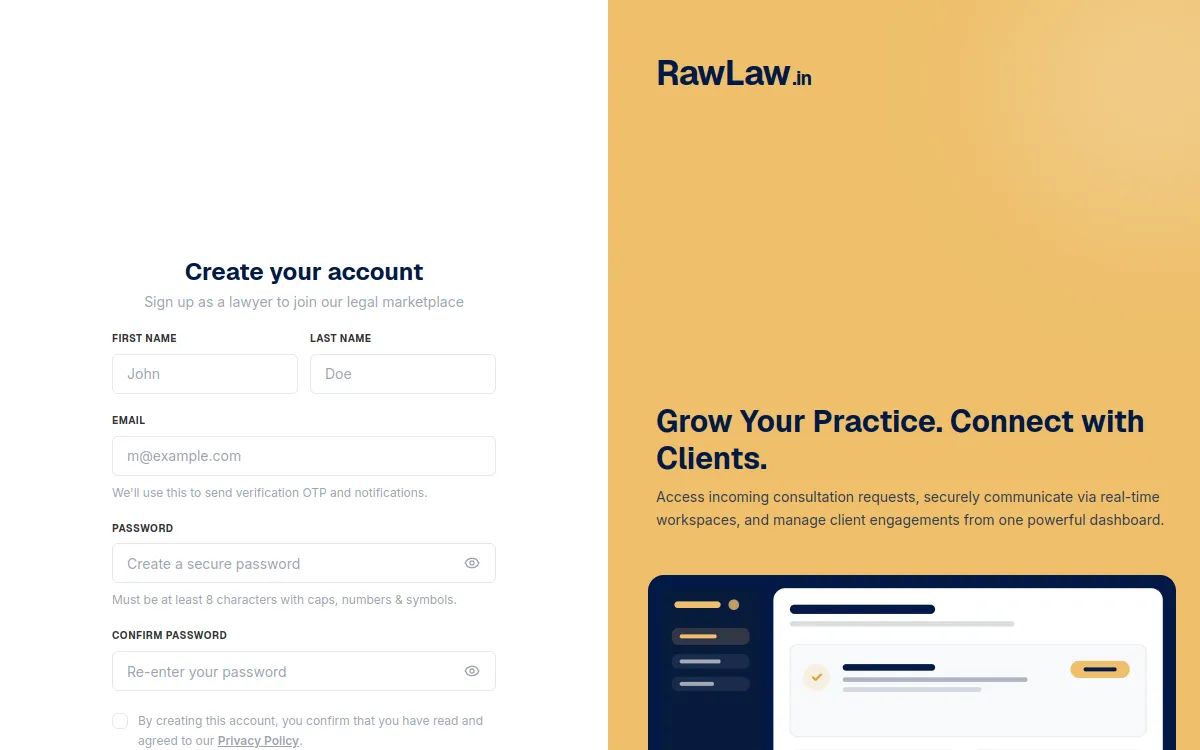
- Advocate account-registration flow at app.rawlaw.in.
Active development or product direction
- Lawyer marketplace and expanded discovery journeys.
- Citizen and advocate workspaces for ongoing matters.
- Administration, moderation, reviews, notifications, and payment workflows.
Platform scope
The product model is organized around five connected capability areas.
- Editorial engine: Legal news, judgments, explainers, topic pathways, and search-led discovery.
- Lawyer marketplace: Profiles, practice areas, verification signals, and relevant opportunities.
- Citizen legal-help flows: Issue classification, jurisdiction, language, urgency, and secure follow-up.
- Lawyer workspace: Communication, matter context, proposals, documents, and engagement management.
- Administrative governance: Editorial controls, verification, moderation, operations, support, and platform safety.
Architecture map
Independent domains create clearer operational boundaries while preserving a connected user journey.
| Surface | Primary role | Responsibilities | Delivery state |
|---|---|---|---|
rawlaw.in | Editorial and discovery | News, judgments, explainers, topic pathways, legal-help entry points, and organic search acquisition. | Public |
app.rawlaw.in | Marketplace and workspace | Registration, profiles, query participation, communication, proposals, and matter workflows. | Partial public surface and active development |
api.rawlaw.in | Business logic and data services | Identity, queries, profiles, notifications, permissions, integrations, and shared application rules. | Architecture direction |
admin.rawlaw.in | Operations and governance | Editorial review, advocate verification, moderation, support, reporting, and administrative controls. | Architecture direction |
Frontend, UX, accessibility, and governance
The experience model prioritizes clarity for people entering a complex and high-trust domain.
- Plain-language prompts reduce dependence on legal terminology during initial intake.
- Progressive disclosure keeps document uploads and sensitive actions inside appropriate authenticated workflows.
- Semantic structure, keyboard access, visible labels, validation guidance, responsive layouts, and reduced-motion support form the accessibility baseline.
- Clear status, verification, privacy, moderation, and review signals support informed decisions without promising outcomes.
- Performance budgets and separation of editorial and application assets protect discovery experiences from application complexity.
SEO, SXO, AEO, and GEO strategy
Search visibility is treated as part of product architecture and content quality, not as a metadata task added after development.
- Create crawlable pathways around topics, jurisdictions, courts, judgments, and practical legal-help needs.
- Connect informational intent to relevant next steps without placing disruptive conversion pressure on editorial content.
- Use direct answers, clear definitions, structured headings, authorship, dates, and source context.
- Keep visible content and structured data aligned across editorial and profile entities.
- Separate indexable authority content from private, duplicate, filtered, or account-based application states.
Intended product and business outcomes
The following outcomes describe product intent and measurement targets. They are not presented as achieved results.
- Create clearer continuity between legal information and a structured next step.
- Improve the quality of issue context available before advocate review or consultation.
- Support more relevant advocate discovery through practice area, jurisdiction, language, and issue signals.
- Strengthen operational safety through verification, moderation, permissions, and auditable workflows.
- Allow editorial reach and application workflows to scale independently.
Demonstrated strengths
- Translating a multi-sided product into clear domains, roles, responsibilities, and journeys.
- Connecting editorial authority, user experience, search visibility, and action paths.
- Designing frontend systems around maintainability, responsive behavior, accessibility, and performance.
- Planning governance across privacy, moderation, verification, permissions, and operational tooling.
- Separating public evidence from active development and future product direction.
Active-development disclosure
Constraints and disclosure
RawLaw remains in active development. Public pages may change as editorial, marketplace, workspace, and governance systems mature. Architecture descriptions document the current product direction and do not guarantee that every capability listed on this page is publicly available. No traffic, ranking, performance, conversion, revenue, or adoption result is claimed.
Public surfaces
Dated captures document the public experience available when this case study was published.